Elliot Worsell Uncrowned Thu, October 15, 2026 at 12:00 PM UTC · 15 min read About Our Ads Advertisement Advertisement Advertisement In most abusive and traumatic relationships, we implore the person damaged to get out and never go back. Only in this way, by creating and maintaining distance, can the victim/survivor hope to process loss and break the trauma bond desperate to return him or her to that same place of pain and hurt. Only in this way will friends be spared from hearing one day, "No, it's OK. It will be different this time."
In boxing, where trauma is the aim, we are less inclined to keep human beings safe from harm. In fact, whenever we see a bloody and dramatic fight, our instinct is to clap our hands and beg for more. Often, with the two boxers still standing in the ring, tired and not yet cleaned, we will listen as they answer questions not only about the past — what has just transpired — but future battles, too. We wish to see them asked about the next one and, if required, given the megaphone and platform to issue a callout. We want to know if they would consider, for our entertainment, a rematch, stopping short of chanting, "Do it! Do it! Do it!" Most of the time we forget to even say please. We just expect it.
Sometimes a boxer's "yes" will be a reflex action, like the snap of a jab, whereas other times there is a greater sense of having been cajoled; the jabbing arm twisted behind his or her back. Either way, if fans want to see it, and the promoter is willing to pay for it, a rematch tends to be boxing's tried and tested trauma response. It is, for better or worse, just that kind of game. Rather than run from pain, there is money to be made in revisiting the cause of it and finding catharsis in repetition.
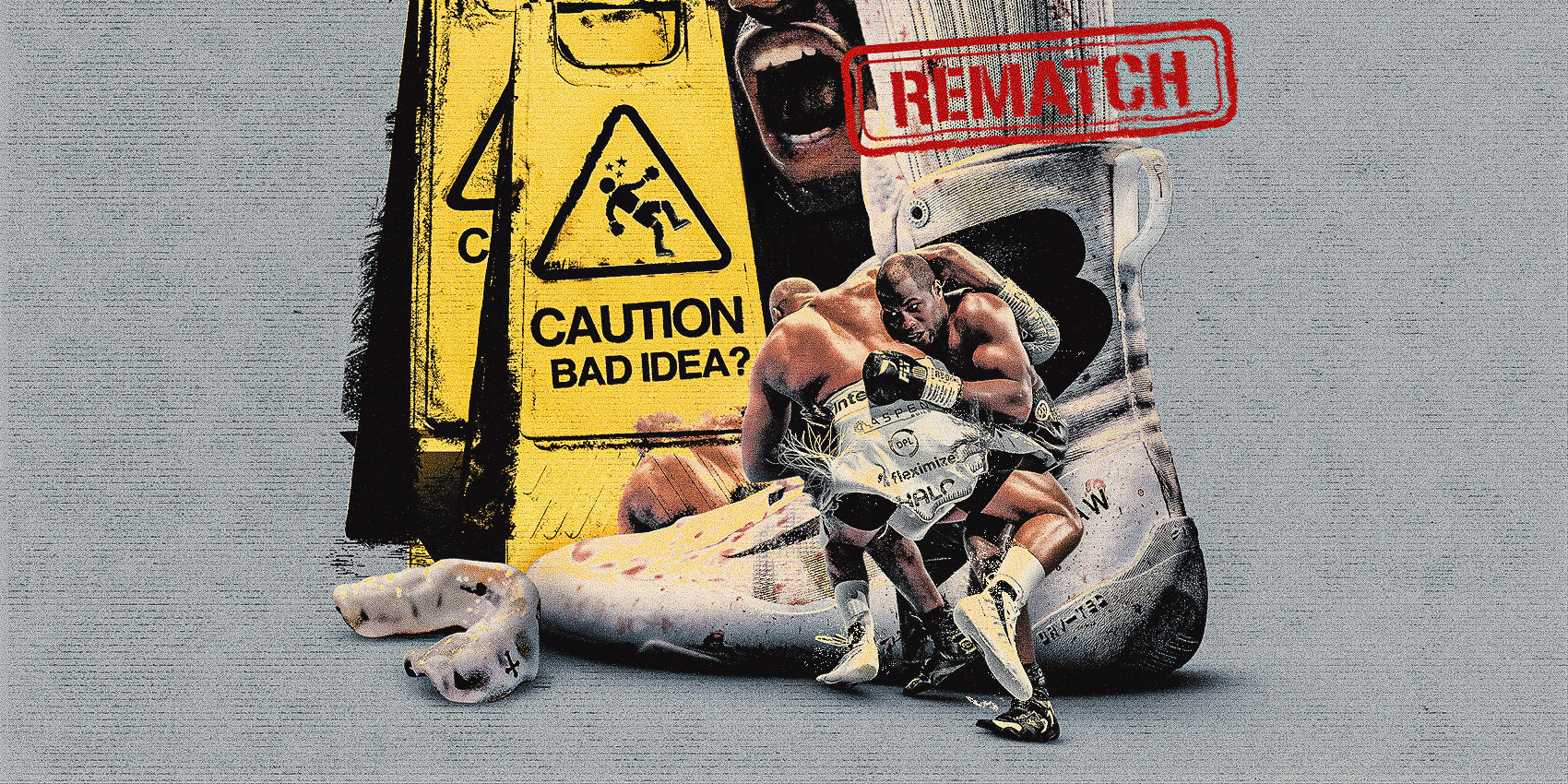
Boxing's next notable rematch takes place Saturday in London, where British heavyweights Daniel Dubois and Fabio Wardley clash again for the WBO heavyweight title. This is a repeat of their fight in May , which ended with Dubois, the challenger, stopping Wardley, the champion, in the 11th round of what was arguably the best fight of the year .
As if that first offering — a conclusive stoppage in a grueling affair — was neither violent nor bloody enough to sate us , we were all quick to demand more. We saw the mess Dubois' fists had made of Wardley's face, yet our collective concern for the beaten man lasted only as long as it took a cutman to wipe away the blood with a towel and a ringside doctor to allow him to stagger back to his feet. After that, we were permitted to once more see Wardley not as a human being but a fighter, a machine, an entertainer. By the time Dubois was asking us, "Are you not entertained?" we had started to wonder what he and Wardley would do next. We asked ourselves, "Would it be different next time?"
WBO heavyweight champion Daniel Dubois and Fabio Wardley rematch Saturday, just five months after their destructive first bout. (Hayden Hodge, Yahoo Sports)
That brutal first encounter between the pair was billed as "Don't Blink," which teased something brief, and early on it was plain to see why. In fact, when Wardley dropped Dubois with his first proper punch — a right hand in Round 1 — it was hard to imagine the fight being anything but brief; often the reality of fights between heavyweight punchers. When Wardley then repeated the trick in Round 3, flooring Dubois for a second time, the fight seemed as good as over, with the same true of their rivalry.
Yet Dubois, no stranger to adversity, had other ideas. "Just a war," he says now, whenever pushed to recall the events of the first fight, and that is indeed what it became. It became a war on account of both Dubois' stubborn refusal to stay down and his equally impressive ability to control Wardley with his jab and power shots before forcing his way into a position of dominance during the middle rounds. By the fight's second half, it was actually Dubois and not Wardley who was the one doing most of the damage. By then, so severe was the damage done to Wardley, the story and message of the fight had changed. Now the advice to not blink had been replaced by a recommendation to watch through fingers, or look away completely. Suddenly, in the blink of an eye, a fight that a few minutes ago was a must-watch became a fight hard to watch through Rounds 10 and 11.
For Wardley's sake, and our own, we willed it to end. We wanted someone, either the referee or a cornerman, to take charge and remove that growing feeling of discomfort. We wanted Wardley to be saved both from Dubois and himself.
Of course, when he finally was, everything was OK again. Better yet, the second we saw Wardley ruefully smile and embrace Dubois, we were again able to extract our emotions from the spectacle and tap back into the detachment of the bloodthirsty. Saved he might have been, but only for another day.
Fabio Wardley suffered immense facial damage in his loss to Daniel Dubois.
Frank Warren, the man responsible for bringing them together, called it the best heavyweight fight he had ever promoted. Then, once informed that the DAZN audience watching at home had voted to see an immediate rematch, he said in the ring, "There is a rematch clause in the contract …" and left it there. We knew, given the context, exactly what that ellipsis meant.
As for Wardley, the one who exited the ring looking different than how he entered, there was never any doubt he would want to do it again. Aside from the fact he had dropped Dubois twice, and appeared on the brink of winning at one stage, Wardley also has a history when it comes to immediate rematches and corrections. In 2024, for instance, he renewed hostilities with Frazer Clarke just six and a half months after battling to a 12-round draw with the one-time Olympian in London. That first Clarke fight was an arduous, bloody battle, the kind likely to steal years from the two fighters involved, and perhaps it was for that reason Wardley wanted a 13th round sooner rather than later. Or maybe he had learned something from those initial 12 rounds and now couldn't wait to fix his mistakes in a rematch.
Whatever the impetus for Wardley, he renewed acquaintances with Clarke in Saudi Arabia and this time stopped Clarke inside the first round, a result nobody, not even Wardley, could have predicted. Shocking enough in isolation, the win was made all the more shocking by virtue of it having followed such a competitive first meeting between the pair earlier that year.
Wardley's hope now is that something similar will unfold when he reconnects with Dubois on Saturday. "I definitely made some mistakes — evidently more than him, because he won the fight," Wardley (20-1-1, 19 KOs) said of his May fight with Dubois. "I think mine are very much clear and obvious for me to fix and change. I also have a proven record of being able to do that as well — going into a rematch with the same opponent. Except from the first Frazer Clarke fight, I came away with a draw. In this fight [against Dubois], I came away with a loss. But you just go back to the drawing board, assess, have a look at yourself and change it around."
True as it is that the loser of a fight seldom has to look far or hard for ways to improve, Dubois, the victor, will be just as eager to work on the errors he made. After all, while the result itself was impressive, and the performance too, there were enough mistakes and knockdowns suffered for Dubois to view a rematch with Wardley as more than just a case of going over old ground.
"I'm going to come in as champion and just demonstrate my skill and pedigree," said Dubois (23-3, 22 KOs). "I've got to put things right this time and be sharp off the mark, more precise, and take him out in style. Just raise my level now and break him down again."
Daniel Dubois stole hard-earned victory from the jaws of early defeat in May.
Twenty-five years ago, another British heavyweight, Lennox Lewis, managed to both lose and regain his world heavyweight titles in the space of seven months. His opponent and nemesis was Hasim "The Rock" Rahman, a top-10 contender few expected to be competitive, never mind dethrone Lewis. Yet, with a single right hand thrown inside a ring in Brakpan, South Africa, that is precisely what Rahman did.
More than just an upset, what occurred in Carnival City that April was seen as an aberration, a cautionary tale; a reminder that a champion should never take a challenger lightly, especially at heavyweight, and that underdogs sometimes have their day. One look at Lewis and you could tell that he wasn't right, they said. But why? Some, post-fight, believed it was the altitude and his failure to acclimate that made him appear lazy and lethargic and unable to raise his left glove to block right hands, while others pointed to him juggling training with shooting scenes for the new "Ocean's Eleven" film as a sure-fire sign of a champion slipping toward complacency.
In the end, though, it didn't matter how or why it had happened. It just needed correcting — hence the rematch, seven months later.
That night, at the Mandalay Bay in Las Vegas, Lewis slept in the changing room prior to the fight and woke from his slumber with a seriousness he clearly lacked in South Africa. There was a renewed confidence, too, something that could perhaps be attributed to Lewis knowing his battery was only half-charged for the first bout. Of course, had Rahman beaten him at his best, this mindset, as well as the speed with which he rematched Rahman, might have been very different. But because Rahman hadn't beaten the best version of Lewis, the feeling going into the second fight was one of urgency, severity and purpose. One could see that in the way Lewis maneuvered around Rahman early on and peppered him with his long, snappy left jab, as if to tame and teach him, put him back in his place. It then became abundantly clear in the way Lewis set up and committed to the right hand with which he poleaxed Rahman in Round 4.
"I just stayed focused," said Lewis in the ring afterward. "When we were in South Africa, I said the belts were on loan. He's had his 15 minutes of glory and now they've come back home to me."
"Do you now acknowledge that you didn't take him seriously in South Africa?" asked HBO's Larry Merchant.
"Well, you know, I didn't take him seriously enough ," said Lewis. "I was in good shape in Africa, but he got through with one punch when I was a little not focused. We're in the heavyweight business. You can end things with one punch."
Lennox Lewis made short work of Hasim Rahman in their 2001 title rematch.
For other heavyweights, chasing an immediate rematch is sometimes a harder call to make. Take Tyson Fury and Anthony Joshua, for example, who both had to decide whether it was wise to fight Oleksandr Usyk again having been soundly beaten by him the first time they met. In both instances the rematches took place, yet the results, as most expected, were almost identical. In the case of Joshua, his September 2021 points loss to Usyk was followed by another August 2022 points loss, while Fury, outpointed by Usyk in May and December of 2024, had even less time between his defeats, not that it mattered. Fury, like Joshua before him, may have had brief periods of success against Usyk, but never was there any sense that he wasn't for the most part being controlled by the great Ukrainian and, ultimately, taught a lesson.
Which, I suppose, begs the question: Why put yourself through the same ordeal twice? Hope is one thing — only natural — but there was at the time no indication that Usyk's first wins against Joshua and Fury were flukes, robberies or one-punch catastrophes. Instead, Usyk beat them the way he beats all his opponents: By exposing their technical limitations and taking their belief and their hope.
That said, Fury and Joshua are two proud champions with histories of success in immediate rematches. You might recall how Fury, as WBC champion, followed a seventh-round stoppage of Deontay Wilder in February 2020 with an 11th-round stoppage of the same opponent in October 2021. Joshua, on the other hand, was even more impressive in how he erased his shocking sixth-round loss to Andy Ruiz in June 2019 with a revenge win just six months later.
"Last time I realized I hurt the man and I got caught coming in," said Joshua, having snatched his WBA, IBF and WBO belts back from Ruiz in Saudi Arabia. "I gave the man his credit. No excuses, right? But I said to myself that I would correct myself and come again. I just wanted to put on a great boxing masterclass and also show the sweet science of this lovely sport. It's about hitting and not getting hit."
Though only six months had passed, the change in approach was clear for all to see. In Joshua, we saw a heavyweight carrying the trauma of the first bout in both his style and the focus in his eyes. We got from him a far more cautious and at times negative display in Diriyah, but one that was also smart and correct and largely responsible for him exacting revenge that night.
Ruiz, meanwhile, also carried the ghosts of the first fight into his performance. If before, in New York, the American's courage and power came as a surprise to Joshua, now Ruiz had to try something else, which, we discovered, was beyond his capabilities. Moreover, in the six months between fights, Ruiz had, like Rahman 25 years ago, walked like a champion, talked like a champion and indulged like a champion, ensuring he was now twice the man but half the fighter he used to be. Now the task of rediscovering the hunger of a challenger was almost impossible for Ruiz to achieve.
The Anthony Joshua rematch did not go well for Andy Ruiz Jr.
When Daniel Dubois suffered the first loss of his professional career, against Joe Joyce in November 2020, he did two shrewd things. One, he stayed down in Round 10 when in danger of losing his sight due to a broken eye socket, and two, he soaked up the post-fight criticism and waited for the moment to pass. Which is to say, despite all his anger and frustration, Dubois resisted the temptation to rematch Joyce — an older, more experienced, tougher man — in the faint hope that he could overturn the loss and silence his critics.
Instead, he licked his wounds, made peace with the setback and continued on his own path. In doing so Dubois reminded us that sometimes a boxer refusing a rematch can be as important to his or her development as agreeing to one, and that not every "war" or painful defeat must be followed with a repeat prescription. As it is in life, maturity in boxing is so often defined by walking away and saying no. Indeed, one need only consider how Dubois surpassed Joyce, his conqueror, in career terms to see the benefit of patience, solid matchmaking and coming to terms with failure.
No doubt Wardley, his next opponent, will have experienced the same quandary after losing for the first time as a pro in May. And yet, whereas Dubois opted to tuck his tail and swallow his pride six years ago, Wardley has decided to return to that same dark place, believing himself to be healed, ready for it. He might forever wear the mementos of battle on his face — the scar tissue around the bridge of his nose, for starters — but he can, for now at least, acknowledge the distinction between surface damage and something deeper.
Dubois and Wardley already gave us one heavyweight classic in 2026. Can lightning strike twice?
"I triggered the rematch clause as soon as I could," said Wardley, who admits he was "trigger happy" and a "victim of his own success" in the first fight. "I think a lot has been made of the aesthetic, how it looked, but ultimately, on the face of it, it's a boxing match between two big heavyweights. You're probably going to come out with a bruise, a cut or two. I think a bit of a meal was made of it really. This [taking a rematch] is nothing new to me. By no means do I expect to get through this sport unscathed. Not many do."
"He can't do anything different," said a straight-faced Dubois in response. "He can't change his style. He'll come out, try hard again, but I'll have an answer for him."
Implicit in the term "immediate rematch" is a suggestion that questions have yet to be answered. Generally speaking: Will the upset be corrected? Will the judges get the scorecards right this time? Can Fighter A alter his style and surprise Fighter B?
But then you get a rematch like Dubois-Wardley 2, which seems not so much concerned with unanswered questions as simply prolonging the drama and uncertainty of five months ago. Rather than answers, we, the audience, just want more of the same — more twists and turns, more punches, more blood, more damage. Like last time, we want more reasons to watch and more reasons to look away. In fact, we expect it.
Source: Sports


0 Comments